Buying guide
Winter Car Gadgets for Canadian Drivers: What Actually Helps in 2026
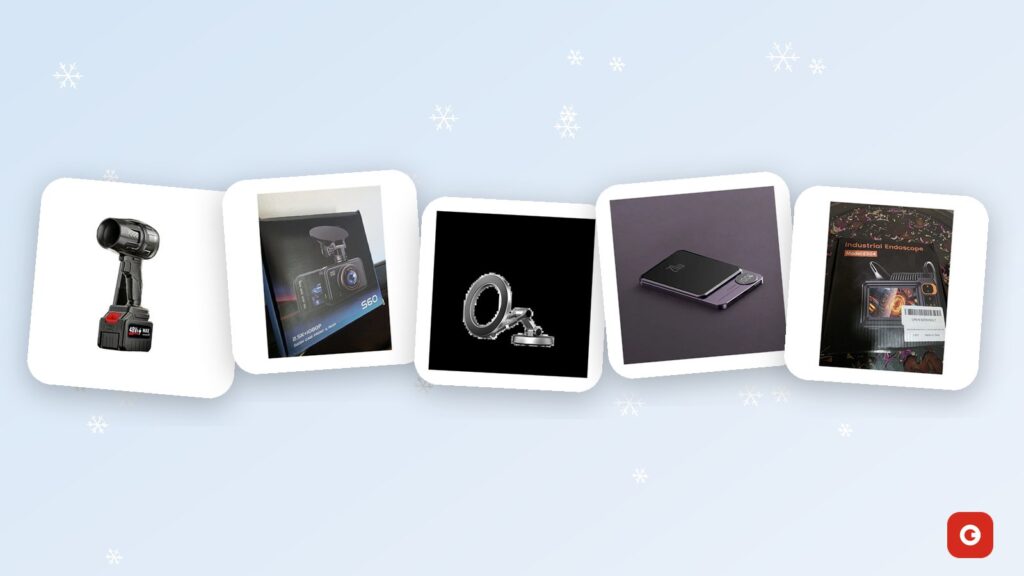
The best winter car gadgets don’t fight a Canadian winter for you. They take minutes off the jobs you already do: clearing a dusting of snow at 7 a.m., keeping a phone alive at −20 °C, recording the drive home in the dark, or checking whether the plow has buried the end of the driveway again. The wrong ones promise to replace your snow brush and end up in the trunk next to booster cables nobody has tested in years.
This guide is for Canadian drivers in every kind of winter: a Calgary or Winnipeg morning after the block heater has been plugged in all night, Montréal and Ottawa slush, the salt spray of a 401 commute, and the heavy, wet snow of Halifax or the Lower Mainland. For each gadget we explain the winter job it does well, its honest limits and how to set it up so the cold doesn’t beat it. Every product we mention is one Gadget Canada actually sells, priced in Canadian dollars, and when a product sheet doesn’t confirm something, such as a runtime or an operating temperature, we say so instead of guessing.
Gadget Canada is an independent store for new and open-box gadgets in Canada. The blower, phone mount, power banks and inspection camera here are new, with a 1-year limited warranty. The dash cams, driveway cameras and dehumidifiers are open box: the packaging has been opened, and each unit is inspected and tested before it ships, with a 90-day limited warranty. None of them replaces winter tires, an ice scraper or careful driving.
Key takeaways
- A cordless air blower is a finisher for light, dry snow and for drying the car after a wash. It won’t move wet, heavy or packed snow and does nothing against ice, so keep a brush and scraper in the car.
- A dash cam only records what it can see. Mount it where the wipers clear the glass, away from airbags and your line of sight, and buy a high-endurance microSD card: neither of our dash cams includes one.
- Install adhesive and suction mounts in a warm car. Hand-held phone use while driving is illegal across Canada, and the rules on mounted devices vary by province.
- Cold temporarily saps lithium-ion batteries. Carry power banks in an inside pocket, don’t leave them in the car overnight, and let them warm to room temperature before charging.
- Solar driveway cameras get little sun in December and can be buried by snow: face the panel south, brush it after storms, and confirm cellular coverage before choosing 4G.
What winter does to your car and your gadgets
Winter goes after a car from four directions at once, and each one explains why some gadgets help all season while others quietly give up by January.
Cold drains every battery
Batteries run on chemistry, and chemistry slows down in the cold. A car’s 12-volt battery has less starting power on a −25 °C morning, which is why so many drivers on the Prairies and in the North plug in a block heater, often on a timer. The lithium-ion cells in a phone, a power bank, a cordless tool or a security camera also deliver less energy when they’re cold. The loss is temporary and they recover once warm, but they should be charged at room temperature, not straight out of a frozen car. Cold also stiffens glue: adhesive pads and suction cups hold poorly on frozen surfaces.
Three kinds of snow, plus ice
Light, dry snow after a cold, clear night sweeps off easily. Wet snow from a coastal storm or a system hovering around 0 °C is heavy and sticky. Freezing rain glazes the whole car in ice. No single tool handles all three. Whatever falls, clear the whole car before you drive: windows, mirrors, lights, sensors and the roof. Roof snow can slide over the windshield when you brake or blow onto the car behind you, and many provinces require clear visibility before you set off.
Slush and road salt
Road salt and brine keep highways open, but they film the windshield, cake onto camera lenses and work into wheel wells, door seals and the underbody, where they speed up rust. And a car that leaves a car wash dripping, then sits outside at −15 °C, can have frozen doors and mirrors by morning.
Darkness and condensation
Around the winter solstice the sun sets between about 4 and 5 p.m. in most Canadian cities, so many commutes start and end in the dark. That’s when a dash cam’s low-light performance matters, and when a solar panel isn’t charging anything. And when you bring a cold gadget into a warm, humid house, moisture forms on it, and sometimes inside it, the way glasses fog up. Let cold electronics warm up gradually, ideally in a closed bag, before you switch them on or plug them in.
The winter car gadgets worth owning respect these limits. Transport Canada’s winter driving guidance covers the vehicle side of the same preparation, from tires to emergency kits.
Clearing light snow faster: brush first, then a cordless air blower
A cordless air blower is the winter gadget drivers ask us about most, and the one most likely to be oversold, so let’s be precise. Our Cordless Turbo Air Blower 48VF MAX ($49.99, new) is a compact, pistol-grip blower with a multi-blade turbine, a wide nozzle and a removable lithium-ion battery, so it works without an extension cord. The manufacturer designed it to chase away dust, debris, crumbs and water, and to dry or dust off a car, a workbench, a patio or outdoor gear.
What it does well, and what it won’t do
In winter, it’s a quick finisher for light, dry snow: the windshield, rear window, roof and hood after a cold, clear night, plus side mirrors, grilles, parking sensors and the backup camera lens, where a brush can’t reach or might scratch. It also clears a light dusting from the front steps.
It isn’t a snow blower, and it won’t clear a driveway. It won’t move wet, heavy snow, the packed band at the bottom of the windshield, the ridge the plow leaves at the curb or anything frozen, and it does nothing against frost, ice or freezing rain. Keep a brush and scraper in the car all winter. “48VF MAX” is the label on the battery, not a performance figure, and our product sheet doesn’t list airflow, runtime, charge time or what’s in the box, so if those matter to you, ask our team before you order.
| Winter job | Snow brush | Ice scraper | Cordless air blower |
|---|---|---|---|
| Light, dry, fluffy snow | Yes | No | Yes, quickly and without touching the paint |
| Wet, heavy or packed snow | Yes, with effort | Partly, for packed edges | No |
| Frost, ice and freezing rain | No | Yes, with the defroster running | No |
| Mirrors, grilles, sensors and lenses | Awkward | No | Yes, for light snow and water |
| Water after a car wash | No | No | Yes |
| Where it lives | In the car | In the car | Indoors, with its battery |
A five-minute routine for a light-snow morning
- Start the car and switch on the front and rear defrosters, where your municipality’s idling rules allow it.
- Brush the roof first, so nothing slides onto glass you’ve already cleared.
- Blow the glass and mirrors from the top down, aiming the snow away from the open door and from the vents at the base of the windshield, where most cars draw in fresh air.
- Scrape any ice the blower uncovers; the defroster will have started loosening it.
- Finish with the lights, licence plate, parking sensors and backup camera.
Store and charge the battery indoors rather than in the trunk, and let a cold battery warm to room temperature before charging it. A cold battery delivers less, so expect shorter sessions on a frigid morning; our sheet lists no runtime, so we can’t give you one. Never point the nozzle at people or pets, and wear eye protection when blowing grit.
Clear light snow without scratching a thing. The cordless turbo air blower is new, $49.99, with a 1-year limited warranty. Keep your brush and scraper for the heavy stuff.
Drying after a car wash or slush: mirrors, grilles, wheels and door seals
Washing a car in winter isn’t vanity. Salt speeds up rust on the underbody, brake lines and wheel wells, and a salty film on the glass and lenses cuts visibility. Regular washes help, ideally on a milder afternoon or in a heated bay with an underbody rinse. The catch is the water left behind: drive out of a wash at −10 °C and the water trapped in mirrors, door seals, locks and wheel recesses starts freezing within minutes.
Drying a car is one of the jobs the blower’s manufacturer lists. A few minutes with it, in your garage or in the wash bay if the operator allows it, pushes out water a towel can’t reach:
- Side mirrors: the gap between the glass and the housing, which otherwise drips and can freeze the mirror in place.
- Door seals and jambs: open each door and blow along the rubber seal so it doesn’t freeze shut overnight. Do the fuel door, trunk and tailgate too.
- Grilles and emblems: water hides behind lettering and in grille openings, then drips and freezes.
- Wheels and lug nut recesses: water sits in the spokes long after the paint looks dry.
- Sensors and cameras: so they work on the drive home.
After a slushy drive, and inside the car
Park in a heated garage after a slushy commute and the slush melts off the wheel wells and rocker panels. Once the worst has dripped off, blowing the sills and recesses dry leaves less salty water on the car overnight. The blower won’t shift frozen chunks packed into the wheel wells; let them melt rather than kicking them loose, which can crack plastic liners. Aim the water toward a floor drain, not across a walkway where it will refreeze.
Inside, a quick pass with the doors open pushes road-salt dust and crumbs out of the console and vents before you vacuum. Wear eye protection: water and grit bounce back.
Dash cams in winter: mounting, cold and memory cards
Winter is when strange things happen on the road: a car sliding through a stop sign, a pickup reversing into you in a snowy mall lot, a slab of ice flying off a transport truck. A recording can help you show what happened. We can’t promise how an insurer or police service will treat footage, but a clip beats a disputed memory. We carry two open-box dash cams, both $69.99: the packaging has been opened, and each unit is inspected and tested before it ships, with our 90-day limited warranty and 30-day returns.
S60 dual or TOGUARD CE50X mirror?
The S60 dual dash cam records ahead in 2.5K QHD (4.0 MP) and behind in 1080P Full HD at the same time. The manufacturer rates its 170° front lens to cover up to four lanes, and its f/1.8 aperture is designed for clearer footage in low light, which describes most January commutes. A G-sensor locks the clip on impact, and loop recording replaces the oldest unprotected footage. It attaches to the windshield with a suction mount and runs from the supplied car charger adapter.
The TOGUARD CE50X mirror dash cam fits over your existing rear-view mirror and adds a 7-inch touchscreen that records the road ahead continuously in Full HD 1080P. Shift into reverse and the display switches to the waterproof backup camera, with guide lines, which helps when snowbanks narrow the driveway. Our sheet lists no waterproof rating, and salt and slush will coat that lens anyway, so wipe it when you brush off the car, and keep shoulder-checking.
| Winter question | S60 dual dash cam | TOGUARD CE50X mirror |
|---|---|---|
| What it records | 2.5K ahead and 1080P behind, at the same time | 1080P ahead, continuously; rear view when reversing |
| Where it mounts | Suction mount on the windshield | Over your existing rear-view mirror |
| Cold glass | Suction can creep on cold glass; re-seat it in a warm cabin | No suction cup on the glass |
| Low light | f/1.8 aperture designed for low light | Not specified on our sheet |
| Reversing between snowbanks | No reversing guide lines | Automatic rear view with guide lines |
| Memory card | Not included; check the manual | Not included; check the manual |
| Operating temperature | Not listed on our sheet | Not listed on our sheet |
| Best for | Highway commuters who want detail ahead and behind | Tight driveways and underground parking |
Mounting for winter
- Work in a warm car. Clean the inside of the glass with an alcohol wipe and let it dry; suction holds better on warm, clean glass.
- Keep the lens where the glass gets cleared. Mount the S60 high on the windshield, usually behind the rear-view mirror, in the area your wipers and defroster keep clear.
- Keep your view and the airbags clear. The camera and its cable shouldn’t block your view or cross an airbag cover; your owner’s manual shows where airbags deploy. Rules on windshield-mounted devices vary by province.
- Route the rear camera with care, following the manual, or use a professional installer.
- Check it after the first cold night, because temperature swings and the defroster’s heat change how suction holds.
Memory cards, deep cold and parking mode
Neither dash cam lists a memory card in the box. Check the manual for the supported card type and capacity, then choose a high-endurance microSD card made for continuous recording; ordinary cards wear out faster under loop recording. Format it in the camera every few weeks and copy clips you want to keep to a computer.
Our sheets don’t list an operating temperature range for either camera, and we won’t guess one. If your car sits outside through −30 °C nights, ask us before you buy. The S60 sits on a suction mount, so you can bring it inside on the coldest nights; let it warm up in a bag before plugging it back in. Its parking mode needs a hardwiring kit, which isn’t included, and a hardwired camera draws on a battery that has less to spare in deep cold, so have a qualified installer fit a kit with low-voltage protection, or skip parking mode in the coldest weeks.
Record the dark winter commute. The S60 dual and TOGUARD CE50X mirror dash cams are $69.99 each, open box, inspected, tested and covered by a 90-day limited warranty.
Phones, mounts and navigation in the cold
In winter your phone works harder than any other gadget in the car: navigating around a closed highway, checking road reports, calling roadside assistance. Getting it onto the dashboard safely and keeping it working in the cold are two separate jobs.
The rules come first. Hand-held phone use while driving is illegal across Canada, and the rules on mounted devices vary by province, including where a phone may sit and what you may touch while driving. Set your route, playlist and hands-free calling before you pull out, and make changes only when you’re safely parked. A slippery road needs both hands and all of your attention.
Installing a magnetic mount in a cold car
Our magnetic car phone mount ($29.99, new) sticks to the dashboard with a high-strength adhesive base, holds the phone with magnets and folds its double-jointed zinc and aluminum alloy arm flat when you park. The head rotates 360°. MagSafe-compatible phones and cases snap straight on; for other phones, a metal plate is included for the back of the phone or case. Winter tests the adhesive, which bonds poorly in the cold:
- Install it in a heated garage or once the cabin has been warm for a while, never in a car that’s been sitting at −15 °C.
- Clean the spot with an alcohol wipe. Smooth, hard plastic holds best; textured or soft-touch dashboards may not hold as well.
- Test the position with your phone attached before peeling the backing, so the arm clears the wheel, vents and controls and stays away from airbag covers.
- Press firmly and let the adhesive set as the manual directs. A spare adhesive pad is included for a second try.
A bulky winter case without magnets weakens the hold, so use a MagSafe-compatible case or put the metal plate on the outside of the case. The plate can get in the way of wireless charging, so put it on a case you can take off.
It holds the phone; it doesn’t charge it
For power on the road, a 12 V car charger with USB-C and USB Power Delivery is the usual choice for a recent phone; our USB-C charger guide for Canada explains watts, USB PD and why the cable matters. Expect faster drain on a winter drive: the phone is cold, navigation is running and on rural stretches it spends extra energy hunting for a signal.
Navigation habits for winter drives
- Download offline maps before long drives on northern or rural highways, where coverage can drop out.
- Check the forecast on weather.gc.ca and your province’s road report (often a 511 service) before you leave, and tell someone your route.
- Turn on voice guidance so you don’t need to look at the screen.
- Don’t aim a heater vent straight at a cold phone: going from very cold to very hot can fog the camera and make the phone pause charging.
Keeping phones and power banks alive below zero
Most Canadians have watched a phone drop from 40% to zero at a bus stop in January. The battery wasn’t empty: lithium-ion cells deliver less energy when cold, so the phone may show a low battery or shut down. Warm it up and much of that charge comes back. The effect is temporary, but it can strand you without a phone at the worst moment, like a stalled car on a dark road.
Five rules for lithium-ion batteries in winter
- Carry power banks in an inside pocket, close to your body.
- Don’t store them in the car. A power bank left in the glovebox overnight starts the day cold and weak.
- Charge at room temperature. Let a cold phone or pack warm up before you plug it in.
- Watch for condensation. Coming in from the cold, leave devices in a pocket or closed bag for a while before charging.
- Keep the right cable with the pack, unless the connector is built in.
Our three power banks, compared for winter
All three are new, with a 1-year limited warranty. None of their sheets lists an operating temperature, so the inside-pocket rule applies to all of them.
| Feature | 10,000 mAh slim magnetic | Magnetic wireless with kickstand | Mini pocket power bank |
|---|---|---|---|
| Price (new) | $79.99 | $69.99 | $29.99 |
| Capacity | 10,000 mAh | Not stated on our sheet; printed on the unit | Not stated on our sheet; printed on the unit |
| How it charges your phone | Magnetic wireless (MagSafe-compatible) or wired | Magnetic wireless, up to 15 W | Built-in Lightning or USB-C connector, depending on the version |
| Rated output | 20 W maximum | 15 W wireless | Not stated |
| Winter strength | Known capacity, slim enough for an inside pocket | Kickstand props the phone up at the chalet | No cable to forget; cheapest to keep in a coat |
For a commuter who wants one pack in the coat all winter, the 10,000 mAh ultra-slim magnetic power bank is the clearest choice, because its capacity is on the listing. The magnetic wireless power bank with kickstand suits ski days and cottage weekends; the manufacturer says it can also top up a smartwatch and other wireless accessories, so check that yours charge wirelessly. The mini pocket power bank is the budget emergency top-up that plugs straight into the phone; iPhone 15 and later use USB-C, earlier iPhones use Lightning, and we’ll confirm which version is in stock.
Wireless charging is convenient but generally less efficient than a cable, so when the cold has already cut a pack’s output, a cable gets more of it into the phone. MagSafe is a trademark of Apple Inc.; our magnetic power banks and mount are third-party accessories, not made or endorsed by Apple. Our power bank buying guide for Canada explains capacity and watt-hours, and our travel tech essentials guide covers what to pack for a winter road trip.
One more idea for iPhone users: the ultra-thin smart tracker card ($59.99, new), compatible with Apple Find My, slips into a wallet that tends to end up under a seat at the ski hill. It needs an iPhone, iPad or Mac, isn’t for Android, and out of Bluetooth range its location updates depend on Apple devices passing nearby, which can be sparse in a rural lot.
The garage and workshop: inspection camera, blower and dehumidifier
If you have a garage, winter turns it into a workshop, a mudroom and a drying room. Three kinds of gadget earn their space there.
An inspection camera for the engine bay and wheel wells
The AukonVee ES04 industrial endoscope ($99.99, new) has its own built-in HD screen, so there’s no phone to pair or app to install, and it switches on instantly. Adjustable LED lights help in dark cavities and can be turned down to cut glare off shiny metal. Use it to look where you can’t see without taking things apart:
- into cavities in the engine bay, to check for debris or signs of nesting, since rodents look for shelter in parked cars when it’s cold;
- into a wheel well or behind a splash shield, to see where slush and ice have packed in or whether something is rubbing;
- along the underbody when the car is up on a lift, to check for salt build-up.
Use it only with the engine off and cool, never near moving parts such as belts and fans or near live wiring, and never under a car held up only by a jack. Our sheet doesn’t list the probe length, cable diameter, waterproof rating, battery details or whether it saves photos or video, so keep it out of slush puddles and email support@gadgetcanada.ca if you need a particular reach. Store it indoors between jobs.
The blower as a workshop tool
The same cordless blower dusts off a workbench, blows sawdust out of a tool tray and dries tools you’ve rinsed; its sheet calls out workbenches, workshop keyboards, DIY materials and outdoor gear. You’ll find it beside the inspection camera in our tools and DIY section.
A dehumidifier for damp garages, mudrooms and winter gear
A car that comes in covered in snow drops a lot of water as it melts, and wet mitts, snow pants and ski gear add more. Damp air means rust spots on tools, musty smells and gear that never quite dries. Our two open-box dehumidifiers in open-box home appliances are both $109.99, so each ships free:
- The TZ02 has a humidity-control function and a laundry drying mode meant to speed up drying on a rack, touch controls on top, wheels, handles and a drain hose. Hang wet mitts and snow pants on a rack in a small room with the door closed and let the laundry mode help. It’s a helper, not a clothes dryer.
- The Aiusevo AS300 is a compact unit with a digital display and a drain hose, suited to one room that stays damp, such as a mudroom.
Our sheets don’t list a moisture-removal rating, coverage area, tank size, noise level or operating temperature range for either unit, so they’re best in heated spaces: a heated garage, mudroom, laundry room or basement. Ask us before planning to run one in an unheated garage. The drain hose works by gravity, so it needs a floor drain or utility sink lower than the outlet. Neither is a boot dryer. Both are open box, inspected and tested, with our 90-day limited warranty.
Watching the driveway: solar and 4G cameras in a Canadian winter
A driveway camera answers winter questions you can’t see from the kitchen window. Has the snow-removal contractor been by? Did the city plow bury the end of the driveway again? Is a parcel sitting under the snow? The trouble is power: few driveways have an outdoor outlet in the right spot, which is why solar cameras are popular, and winter is exactly when solar is weakest.
The winter limits of solar cameras
- Short days: in December much of southern Canada gets roughly eight to nine hours of daylight, less farther north, and the low sun means a panel collects far less than in June.
- Snow on the panel: even a thin layer blocks most of the light, so brush it off after every storm. A steeper angle helps snow slide off.
- Cold batteries: the camera’s battery stores and delivers less in the cold, like your phone.
- Snow on the lens: where you can, mount the camera under an eave so blowing snow and freezing rain don’t coat it.
Two open-box options
The 4MP PTZ wireless solar security camera ($79.99, open box) connects to your Wi-Fi, recharges its built-in battery from an included solar panel on a cable, and pans and tilts from your phone, with night vision and real-time motion alerts. A USB charging cable is in the box, which matters in winter: top the battery up indoors before mounting it, and after a long grey stretch. Test the Wi-Fi signal at the spot first; distance and exterior walls weaken it, and 2.4 GHz Wi-Fi generally reaches farther than 5 GHz.
The SOLIOM S600-4G solar security camera ($85.99, open box) uses 4G LTE instead of Wi-Fi, for a long rural laneway, a farm gate or a cottage closed for the winter. It needs cellular coverage at the mounting spot and a data plan. An EIOTCLUB SIM card kit is included, but we can’t confirm which networks it uses at your address, so check coverage and plans with EIOTCLUB first. Its separate solar panel can face the sun while the lens watches the lane, and it adds 360° pan and tilt, LED floodlights, night vision and a housing designed for rain and snow.
| Driveway question | 4MP PTZ solar camera | SOLIOM S600-4G |
|---|---|---|
| Connection | Your home Wi-Fi | 4G LTE: SIM, data plan and coverage needed |
| Power | Solar panel on a cable, built-in battery, USB cable for indoor charging | Separate solar panel and rechargeable battery |
| Best winter spot | A driveway within Wi-Fi range | A lane, gate or closed cottage beyond Wi-Fi |
| Winter watch-outs | Short days, snow on the panel, cold battery | The same, plus data costs and rural coverage gaps |
| Price | $79.99, open box | $85.99, open box |
Point the camera at your own driveway and door, not into a neighbour’s windows or yard, and avoid capturing the street more than you need to; the Privacy Commissioner’s guidance on surveillance explains the principles. Change default passwords and keep the firmware updated, as Get Cyber Safe recommends for connected devices. Our outdoor security camera buying guide for Canada goes deeper into power, storage and installation.
Your winter car kit checklist
Gadgets are only half of being ready for winter. The other half is the unglamorous kit that has lived in Canadian trunks for generations. Here’s the checklist we’d tape inside the garage door.
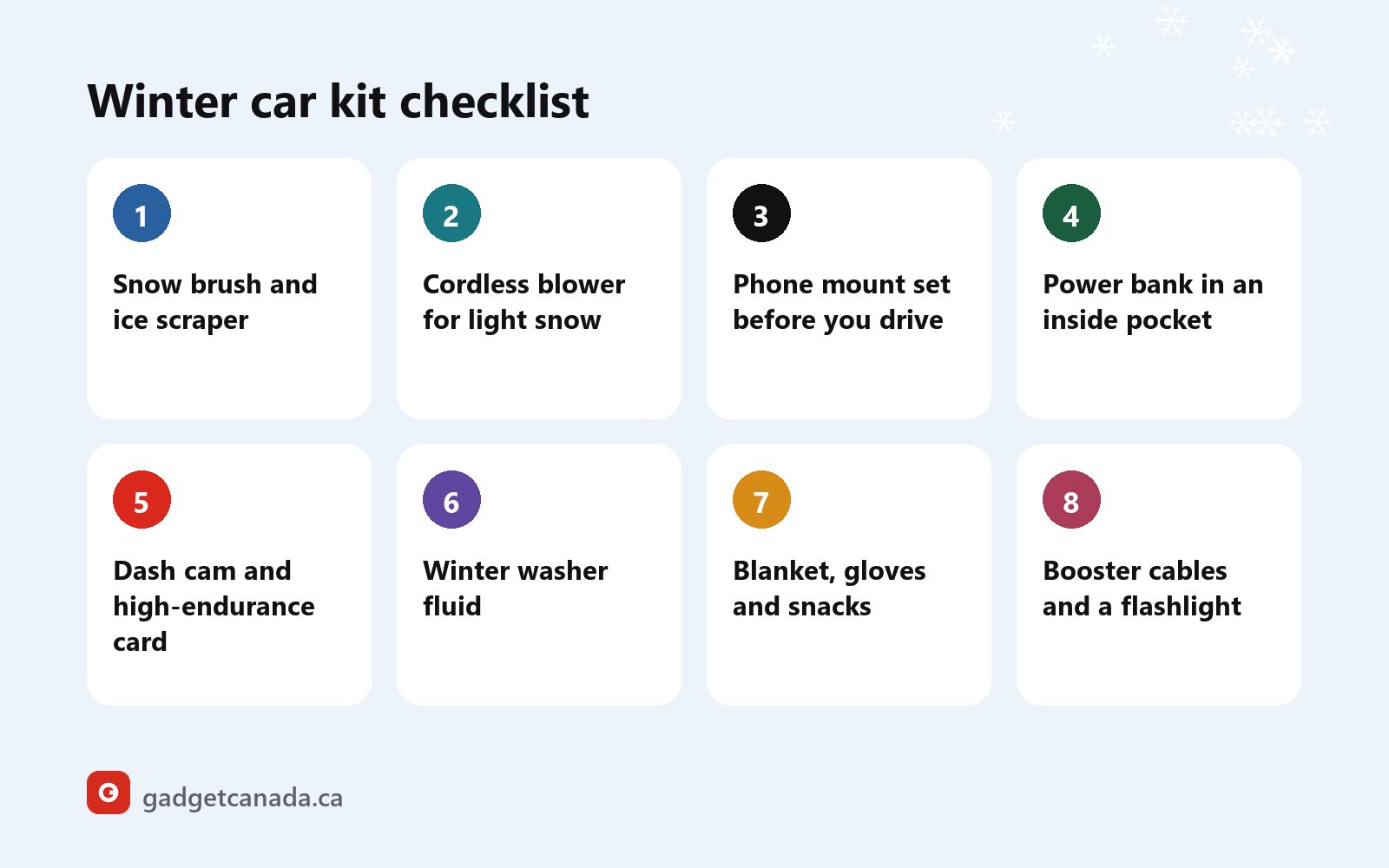
Some of these items are gadgets we sell: the blower, the phone mount, the power banks and the dash cams. Others aren’t, and we’d rather say so than leave them off. We don’t sell snow brushes, ice scrapers, washer fluid, blankets, booster cables, flashlights, shovels, sand or traction mats; any hardware or auto parts store has them.
Before the first big storm
- Check for recalls. Look up your vehicle on Transport Canada’s vehicle, tire and child car seat recalls page, and check your chargers and gadgets against the Government of Canada recalls and safety alerts.
- Put on winter tires. Rules vary: Québec makes them mandatory for part of the year, and British Columbia requires winter tires or chains on many highways in season.
- Switch to winter washer fluid rated for your region’s coldest temperatures, and replace streaky wiper blades.
- Test the battery and block heater. Have the battery tested before the first cold snap, and check the block heater cord for cracks.
- Stock the trunk: snow brush, ice scraper, a small shovel, sand or traction mats, booster cables, a flashlight, a blanket, gloves, water and snacks.
- Charge and stage the blower indoors, by the door you use in the morning.
- Mount the phone and dash cam in a warm car, then format a high-endurance microSD card in the camera.
- Set a power bank routine: charged indoors overnight, in an inside pocket by day.
- Prepare the driveway camera: charge it, angle the panel south and a little steeper, and keep a soft brush handy.
- Before every long drive, check the forecast and road report, keep the tank at least half full and tell someone your route.
If you drive an electric or plug-in hybrid car, cold reduces range too, so warm the cabin while it’s still plugged in where your car supports it. And if you ever get stuck, stay with the vehicle, keep the exhaust pipe clear of snow, run the engine only now and then for heat and make the car visible. That’s when the blanket, snacks and a charged phone in your inside pocket pay off.
Winter car gadgets compared: job, condition and price
Here’s every gadget from this guide in one table, with its winter job, condition and price in Canadian dollars.
| Product | Winter job | Condition | Price |
|---|---|---|---|
| Cordless Turbo Air Blower 48VF MAX | Light, dry snow; drying after a wash; dusting the garage | New | $49.99 |
| S60 dual dash cam, 2.5K front and 1080P rear | Recording dark commutes, ahead and behind | Open box, 90-day warranty | $69.99 |
| TOGUARD CE50X 7-inch mirror dash cam | Recording ahead; reversing between snowbanks | Open box, 90-day warranty | $69.99 |
| Magnetic car phone mount, foldable 360° arm | Holding the phone for navigation set before you drive; doesn’t charge | New | $29.99 |
| 10,000 mAh slim magnetic power bank, 20 W | Inside-pocket power with a known capacity | New | $79.99 |
| Magnetic wireless power bank with kickstand, 15 W | Top-ups at the chalet or the ski hill | New | $69.99 |
| Mini pocket power bank with built-in connector | A cable-free emergency top-up | New | $29.99 |
| AukonVee ES04 inspection camera | Engine bay and wheel wells, engine off and cool | New | $99.99 |
| 4MP PTZ wireless solar security camera | A driveway within Wi-Fi range | Open box, 90-day warranty | $79.99 |
| SOLIOM S600-4G solar security camera | A lane, gate or cottage beyond Wi-Fi | Open box, 90-day warranty | $85.99 |
| TZ02 dehumidifier with laundry drying mode | Drying winter gear in a heated room | Open box, 90-day warranty | $109.99 |
| Aiusevo AS300 home dehumidifier | One damp mudroom or laundry room | Open box, 90-day warranty | $109.99 |
Where to start? Park outside: the blower, with the brush still in the trunk. Commute in the dark: the S60 and a high-endurance card. Navigate by phone: the mount and a power bank for your coat. For holiday gifts, the blower ($49.99), or the mount and mini pocket power bank together ($59.98), are easy picks.
New items carry our 1-year limited warranty and 30-day returns if unused and in their original packaging. Open-box items carry a 90-day limited warranty and 30-day returns in the condition you received them; our open-box grading guide explains how we inspect, test and clean them, and our comparison of open box vs refurbished vs new explains the terms.
Shipping is $14.99 anywhere in Canada, or free on orders over $99. Orders are processed in 1 to 2 business days and delivered in 3 to 7 business days, so order before the first big storm. Pairs that clear the free-shipping line include the blower and the S60 ($119.98), the S60 and the mount ($99.98), and the 10,000 mAh power bank and the mount ($109.98). Questions? Email support@gadgetcanada.ca, Monday to Friday, 9:00 to 17:00 ET. Gadget Canada is an independent retailer, not affiliated with the brands we sell; Apple, Find My and MagSafe are trademarks of Apple Inc.
The bottom line
The best winter car gadgets don’t pretend winter is easy. A cordless air blower handles light, dry snow and wet paint after a wash, but the brush and scraper stay in the trunk. A dash cam records only what it can see through cleared glass. Mounts go on in a warm car, power banks ride in an inside pocket, and solar cameras need a brushed panel and realistic expectations in December.
Start with the job that annoys you most on a winter morning, buy the gadget that fixes it, and keep the basics in the trunk: good tires, winter fluid, booster cables, a blanket and a plan. When you’re ready, browse our winter gadgets and electronics in Canada, and drive safely this season.
Keep your phone charged and in view. Three power banks from $29.99 and a magnetic car phone mount at $29.99, all new with a 1-year limited warranty.
Frequently asked questions
Can a cordless air blower replace a snow brush and an ice scraper?
No. It's useful for light, dry snow on the windshield, mirrors, roof and steps, and for drying the car after a wash. It won't move wet, heavy or packed snow, and it does nothing against ice, frost or freezing rain, so keep a brush and scraper in the car all winter.
What does "48VF MAX" mean on the cordless blower?
It's the label on the blower's battery, not a measured performance figure. Our product sheet doesn't list airflow, runtime, charge time or box contents, so email support@gadgetcanada.ca if you need those details before you order.
Do the S60 and TOGUARD CE50X dash cams work at −20 °C or colder?
Our product sheets don't list an operating temperature range for either camera, so we can't promise how they behave in deep cold. Ask us before you buy if your car sits outside on very cold nights. The S60 sits on a suction mount, so you can bring it inside overnight; let it warm up before you plug it back in.
Is a memory card included with the dash cams?
No. Neither kit lists a memory card. Check the manual for the supported card type and capacity, and choose a high-endurance microSD card designed for continuous recording.
Is it legal to mount a phone or a dash cam on my windshield or dashboard?
Hand-held phone use while driving is illegal across Canada, and the rules on mounted devices vary by province. Check your province's rules, mount devices where they don't block your view or an airbag, and set your navigation before you drive.
Why does my phone die so fast in the cold?
Cold temporarily reduces the performance of lithium-ion batteries, so a phone can show a low battery or shut down even with charge left. Keep the phone and your power bank in an inside pocket, let them warm up before charging, and don't leave power banks in the car overnight.
Will the magnetic phone mount stick in winter?
Its adhesive base bonds poorly in the cold, so install it in a heated garage or a warmed-up cabin, on a clean, smooth surface, and let it set as the manual directs. A spare adhesive pad is included. The mount holds the phone but doesn't charge it.
Will a solar security camera keep working through a Canadian winter?
It can, with limits. Short days and a low sun mean less charging, snow on the panel blocks the light, and cold reduces battery capacity. Face the panel south, brush it after storms and top the battery up indoors if needed. Our outdoor security camera guide covers winter setups in detail.
Can I run one of your dehumidifiers in an unheated garage?
Our sheets for the TZ02 and the Aiusevo AS300 don't list an operating temperature range, a moisture-removal rating or a coverage area, so they're best in heated spaces such as a heated garage, mudroom, laundry room or basement. Email us before you plan to use one in an unheated space.
Does Gadget Canada sell snow brushes, scrapers or booster cables?
No. We sell gadgets such as the cordless blower, dash cams, phone mount and power banks, but not brushes, scrapers, washer fluid, booster cables, blankets, shovels or traction aids. Hardware and auto parts stores carry them, and Transport Canada's winter driving page has more tips on preparing your vehicle.
Are the dash cams and driveway cameras new?
No, they're open box: the packaging has been opened, and each unit is inspected and tested before it ships, with a 90-day limited warranty and 30-day returns. New items such as the blower, phone mount and power banks have a 1-year limited warranty.